The result is a style of dessert that can be crisp, creamy, syrupy and nutty all at once.
There is also an important cultural element. Greek desserts are often connected with hospitality. Sweets may be offered to guests, shared during family gatherings or prepared for important celebrations. In the same way that meze encourages people to share savoury dishes, dessert can extend the pleasure of sitting together at the table.
There are hundreds of regional sweets across Greece, but a few have become particularly well known beyond the country.
Galaktoboureko is one of the great classics of Greek pastry. It combines a smooth custard filling with layers of crisp filo pastry, finished with sweet syrup. The contrast is what makes it so appealing. You get crisp pastry on the outside and soft, creamy custard within.
Urban Greek’s version takes this traditional idea further with accompaniments that add additional texture and fruit flavours, while keeping the familiar custard-and-filo combination at its heart.
For anyone discovering Greek desserts for the first time, galaktoboureko is an excellent place to begin.
Few sweets are as closely associated with Greek and eastern Mediterranean food traditions as baklava. Thin layers of filo are combined with nuts and syrup to create a dessert that is crisp, sticky and rich.
There are many variations depending on region and family tradition. Different nuts can be used, the syrup can carry different aromatics, and the proportions of pastry and filling can vary.
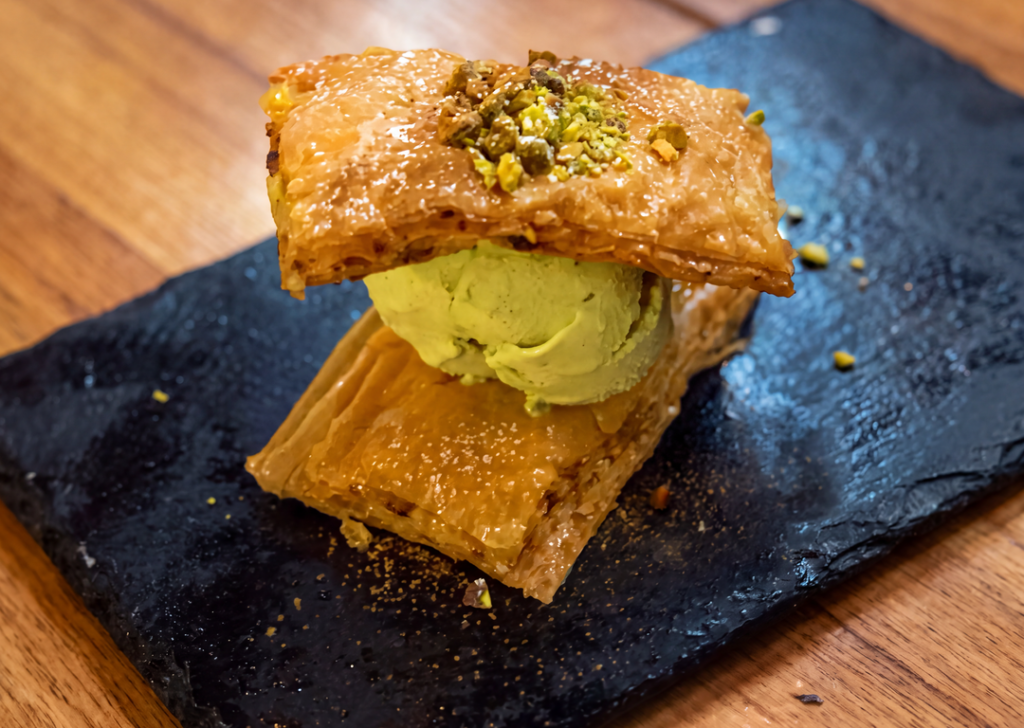
Urban Greek gives the familiar flavours and textures of baklava a playful interpretation with its Baclava Gelato Sandwich, combining pistachio gelato, filo pastry, caramelised pistachios and syrup.
Baklava may be one of the most recognisable Greek desserts, but Greek sweet-making extends far beyond one pastry.
Loukoumades are small fried dough bites traditionally served with honey or syrup, often accompanied by cinnamon or nuts. Halva appears in several forms and is valued for its distinctive texture and straightforward ingredients. Portokalopita brings orange and syrup together in a moist Greek cake, while revani is traditionally based around semolina and syrup.
Seasonal and celebratory sweets are equally important. Melomakarona, for example, are associated with Christmas, while vasilopita has an important place in Greek New Year traditions.
These dishes show how closely food, family and celebration are connected within Greek culture.
Tradition does not mean that a dessert has to remain unchanged forever. Greek cooking has always reflected local ingredients, regional influences and family interpretation.
That philosophy works particularly well with desserts. A familiar pastry can be paired with gelato, seasonal fruit can provide contrast to a sweet element, or a traditional combination of filo and pistachio can be presented in a different form.
At Urban Greek, the dessert selection reflects this balance. Alongside recognisably Greek flavours, the menu includes house-made desserts, gelato and sorbet, creating choices for diners who may want something traditional as well as those who prefer a lighter or more contemporary finish to dinner.
A Greek meal is rarely about rushing through separate courses. It is about conversation, sharing and allowing the meal to unfold.
After dips, meze, salads, seafood, charcoal-grilled dishes or a banquet, dessert becomes another opportunity to keep the table together. Sharing a couple of sweets can also be a good way to experience different flavours without choosing just one.
For first-time diners, this can make exploring Greek desserts part of the wider dining experience rather than simply an extra course at the end.
Greek desserts tell stories about family recipes, regional traditions, celebration and hospitality. From the crisp filo and creamy custard of galaktoboureko to the nuts, syrup and pastry associated with baklava, they offer another way to understand the depth of Greek cuisine.